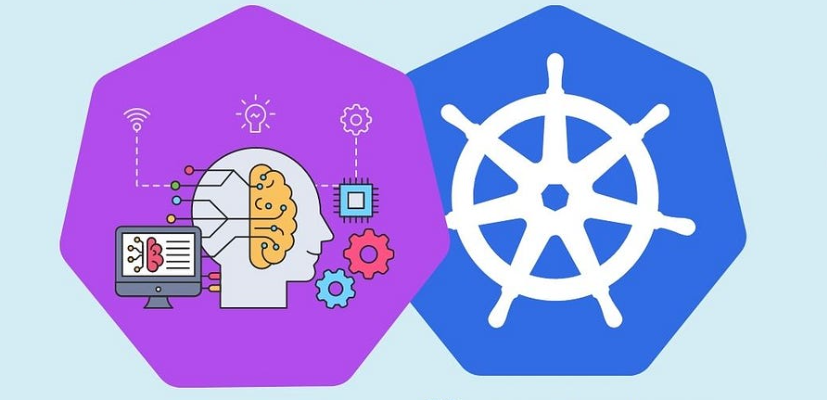
You hear “AI” and “Kubernetes” thrown around constantly. On their own, they are two of the biggest forces in technology. But when you put them together, they solve massive problems for each other.
Think of it this way: AI models are the complex, powerful “brains,” but Kubernetes is the industrial-scale “factory” needed to build and run them.
So, what’s the deal? Why do they need each other?
It boils down to three main things:
Scaling for the Masses: An AI model (like a chatbot or an image generator) is useless if it can’t handle millions of users. Kubernetes excels at scalability. It can instantly create (or “scale-out”) hundreds of copies of your AI model to meet user demand and then scale them back down when traffic is low to save money.
Smart Management for Expensive GPUs: AI workloads, especially deep learning, depend on powerful and expensive Graphics Processing Units (GPUs). Running them efficiently is a major challenge.
- The Problem: Without Kubernetes, these expensive GPUs are often stuck on one server. They either sit idle waiting for a job (wasting money) or are over-utilized, creating a bottleneck.
- The Kubernetes Solution: Kubernetes treats GPUs as a schedulable, shared resource pool.
- Maximum Utilization: The Kubernetes scheduler can find any available GPU in the entire cluster and assign a job to it. This ensures that your costly hardware is always working, not sitting idle.
- Developer Abstraction: Developers don’t need to know which specific machine has a GPU. They simply request one in their configuration (e.g.,
resources: limits: nvidia.com/gpu: 1), and Kubernetes handles all the work of finding and allocating it. - Advanced Sharing: For even greater efficiency, Kubernetes supports technologies like NVIDIA’s Multi-Instance GPU (MIG), which can partition a single, powerful GPU into several smaller, isolated GPU instances for different workloads. It can also “time-slice” a single GPU, allowing multiple smaller tasks to share it.
- Automated Operations: Tools like the NVIDIA GPU Operator automate the incredibly complex task of installing and managing all the necessary drivers and software on every node, which is a massive operational time-saver.
Portability and MLOps: Kubernetes allows you to package your entire AI application (the code, the model, the dependencies) into a container that runs anywhere—your laptop, your company’s private servers, or any public cloud (like AWS, Google Cloud, or Azure). This consistency is the foundation of MLOps (Machine Learning Operations), creating a reliable, automated pipeline to train, test, and deploy models without friction.
The takeaway: Kubernetes doesn’t create artificial intelligence. It provides the essential engine that makes building, deploying, and managing AI at a massive scale practical, efficient, and—most importantly—cost-effective.